CBSE Class 10 Science Chapter 2 — Acids, Bases and Salts (Complete Detailed Study Notes): Fully updated for the 2025-26 Board Examination curriculum. Features comprehensive conceptual explanations, detailed activity protocols for all 15 NCERT activities (Activity 2.1 to 2.15), 6 high-definition vector apparatus diagrams, 6 comparative analytical tables, balanced chemical equations, and CBSE examination callouts.
1. Understanding Chemical Properties of Acids and Bases
In our daily diet and natural environment, we encounter various chemical substances. Sour taste in foods (like lemon and vinegar) is due to acids, whereas bitter taste and slippery texture (like baking soda and soap) indicate bases.
Definition 1: Acids (Arrhenius Concept)
Acids are chemical substances that furnish hydrogen ions $(\text{H}^+)$ or hydronium ions $(\text{H}_3\text{O}^+)$ when dissolved in aqueous solutions. They taste sour, turn blue litmus paper red, and react with active metals to produce hydrogen gas.
Definition 2: Bases and Alkalis
Bases are chemical compounds that dissociate to release hydroxide ions $(\text{OH}^-)$ in aqueous solution. They taste bitter, feel slippery/soapy to touch, and turn red litmus blue. Water-soluble bases are specifically termed Alkalis (e.g., $\text{NaOH}, \text{KOH}$).
Table 1: Comparative Properties of Acids vs Bases
| Characteristic Property | Acids (अम्ल) | Bases / Alkalis (क्षारक) |
|---|---|---|
| Taste & Touch | Sour taste; corrosive touch | Bitter taste; soapy and slippery touch |
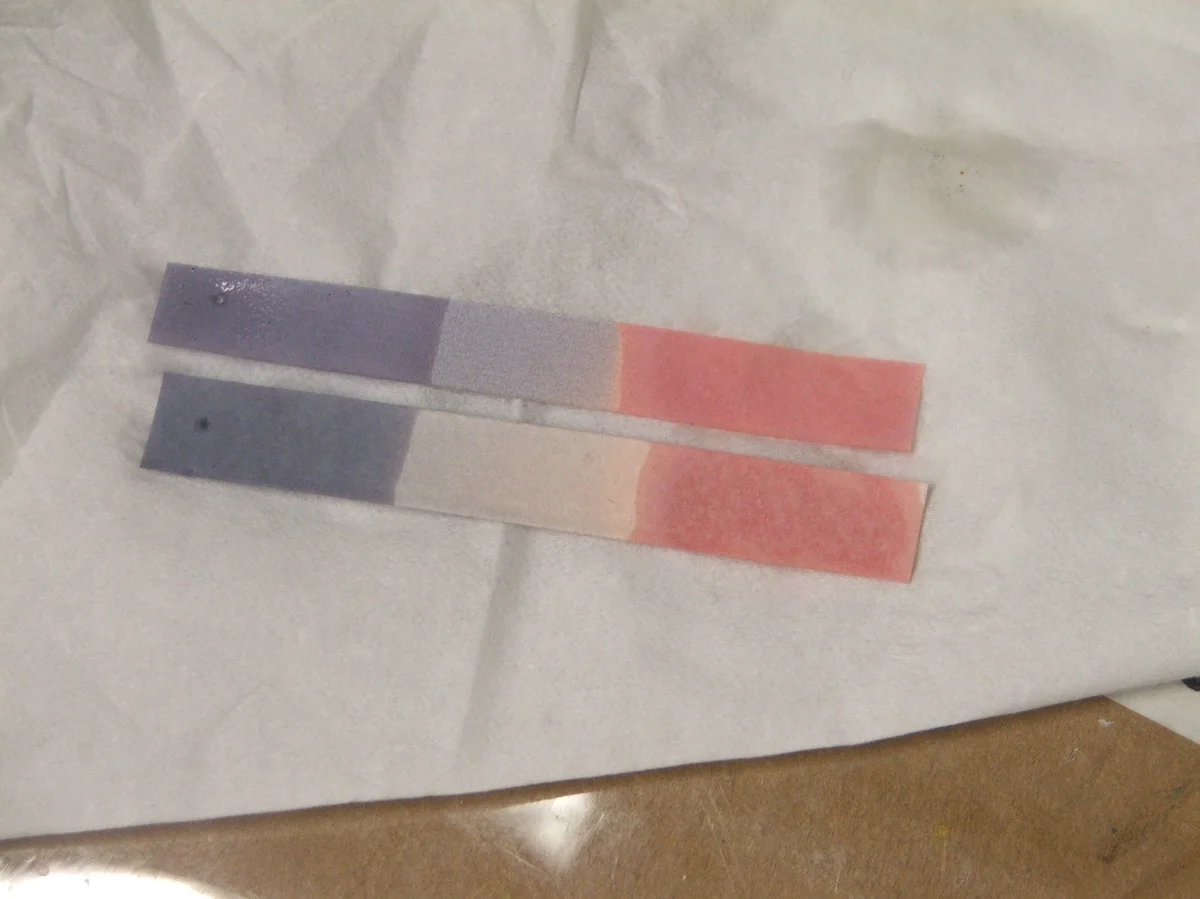
| Litmus Paper Test | Turns Blue Litmus Red | Turns Red Litmus Blue |
| Aqueous Ions Liberated | Hydronium ions $(\text{H}_3\text{O}^+)$ | Hydroxide ions $(\text{OH}^-)$ |
| pH Value at 25°C | $\text{pH} < 7.0$ | $\text{pH} > 7.0$ |
| Common Examples | $\text{HCl}, \text{H}_2\text{SO}_4, \text{HNO}_3, \text{CH}_3\text{COOH}$ | $\text{NaOH}, \text{KOH}, \text{Ca(OH)}_2, \text{Mg(OH)}_2$ |
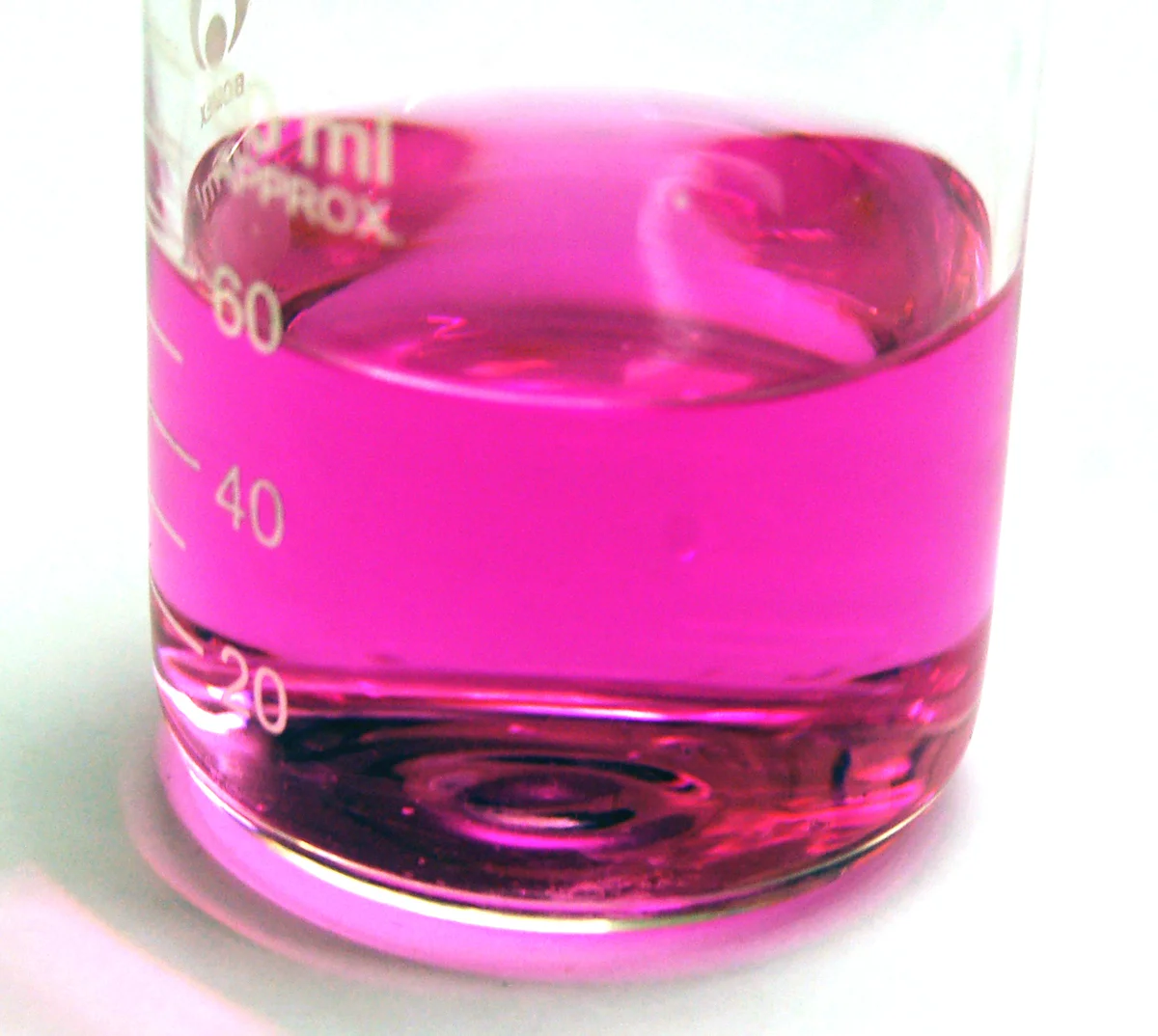
Activity 2.1: Testing Acids and Bases in the Laboratory with Indicators
Collect samples of $\text{HCl}, \text{H}_2\text{SO}_4, \text{HNO}_3, \text{CH}_3\text{COOH}, \text{NaOH}, \text{Ca(OH)}_2, \text{KOH}, \text{Mg(OH)}_2$, and $\text{NH}_4\text{OH}$. Test drops of each with red litmus, blue litmus, phenolphthalein, and methyl orange on a watch glass.
Source: Wikimedia Commons (Public Domain, Chemicalinterest)
Source: Wikimedia Commons (Public Domain, Ben Mills)
Activity 2.2: Olfactory Indicators (Vanilla, Onion, and Clove Oil)
Substances whose odour changes in acidic or basic media are called olfactory indicators. Take finely chopped onions wrapped in clean cloth strips overnight. Treating with dilute $\text{NaOH}$ destroys the characteristic smell, while dilute $\text{HCl}$ retains the odour.
Table 2: Comprehensive Classification of Indicators & Colour Shifts
| Indicator | Type | Original Colour | Acidic Solution | Basic Solution |
|---|---|---|---|---|
| Litmus Paper | Natural (Lichen extract) | Purple | Red | Blue |
| Turmeric | Natural | Yellow | Yellow (No Change) | Reddish-Brown |
| Phenolphthalein | Synthetic | Colourless | Colourless | Pink |
| Methyl Orange | Synthetic | Orange | Red | Yellow |
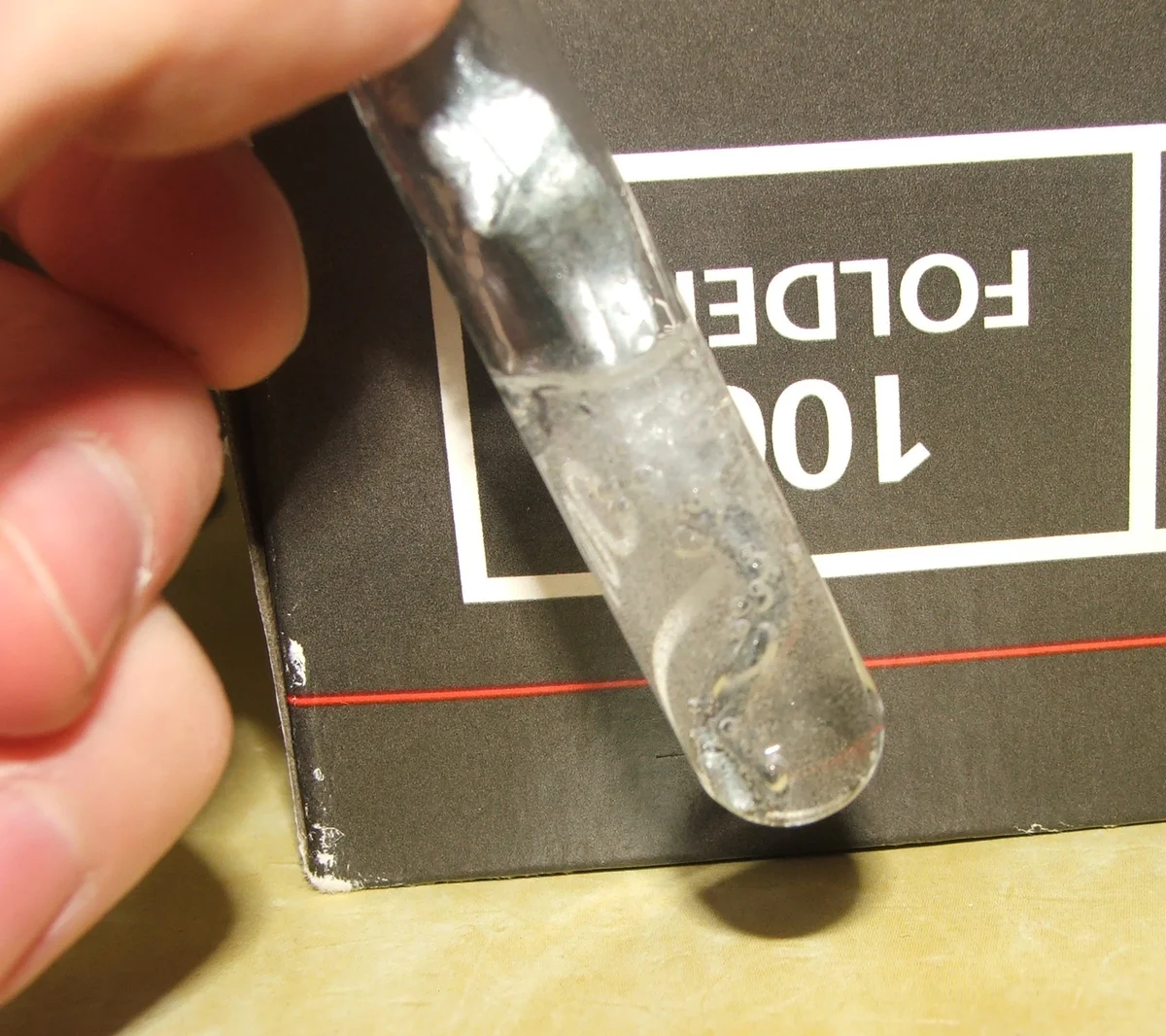
Activity 2.3: Reaction of Zinc Granules with Dilute Sulphuric Acid and Soap Bubble Pop Test
When dilute sulphuric acid reacts with granulated zinc, hydrogen gas is evolved. Passing the gas through soap solution produces bubbles filled with $\text{H}_2$, which burst with a characteristic ‘pop’ sound when touched by a burning splinter.
Activity 2.3: Reaction of Zinc Granules with Dilute H₂SO₄ & Hydrogen ‘Pop’ Test
Source: Wikimedia Commons (Public Domain, Chemicalinterest)
Activity 2.4: Reaction of Metals with Bases
Metals like Zinc also react with strong bases like sodium hydroxide upon heating to form sodium zincate and hydrogen gas: $$2\text{NaOH}(\text{aq}) + \text{Zn}(\text{s}) \xrightarrow{\Delta} \text{Na}_2\text{ZnO}_2(\text{aq}) + \text{H}_2(\text{g}) \uparrow$$
Activity 2.5: Reaction of Metal Carbonates and Metal Hydrogen Carbonates with Acids
Carbonates react with acids to yield salt, water, and carbon dioxide. Passing $\text{CO}_2$ through lime water turns it milky due to insoluble $\text{CaCO}_3$ formation.
Activity 2.5: Reaction of Metal Carbonate with Dilute Acid & Lime Water Turning Milky
Activity 2.6: Neutralisation Reaction (Acid + Base)
Take $2\text{ mL}$ of $\text{NaOH}$ solution in a test tube and add two drops of phenolphthalein (solution turns pink). Adding dilute $\text{HCl}$ drop-by-drop causes the pink colour to disappear. Adding $\text{NaOH}$ again restores the pink colour, proving mutual neutralisation.
Activity 2.7: Reaction of Metallic Oxides with Acids
Black copper(II) oxide dissolves in dilute hydrochloric acid to yield a blue-green solution of copper(II) chloride $(\text{CuCl}_2)$, proving that metallic oxides are basic in nature: $$\text{CuO} + 2\text{HCl} \to \text{CuCl}_2 + \text{H}_2\text{O}$$
2. What Do All Acids and All Bases Have in Common?
Activity 2.8: Electrical Conduction in Aqueous Acidic Solutions
Dilute solutions of $\text{HCl}$ and $\text{H}_2\text{SO}_4$ conduct electricity because they dissociate into free mobile ions. Conversely, aqueous glucose and alcohol solutions contain no mobile ions and do not conduct electric current.
Activity 2.8: Electric Conductivity of Acid Solution in Water (Evidence of H⁺ Ions)
Activity 2.9: Testing Dry vs Moist Litmus with Dry HCl Gas
Dry $\text{HCl}$ gas produced from $\text{NaCl} + \text{H}_2\text{SO}_4$ does not change the colour of dry blue litmus paper. When tested with moist blue litmus paper, it instantly turns red, demonstrating that acids generate $\text{H}^+$ ions only in the presence of water.
Activity 2.9: Action of HCl Gas on Dry and Moist Litmus Paper (Role of H⁺ Ions)
Activity 2.10: Exothermic Dilution of Acids and Bases
Mixing concentrated $\text{H}_2\text{SO}_4$ or $\text{NaOH}$ pellets with water causes a sharp rise in temperature. Dilution must always be carried out by adding acid slowly into water with constant stirring, never water into acid.
Table 3: Strong Acids vs Weak Acids and Strong Bases vs Weak Bases
| Category | Degree of Ionisation | Representative Examples | Key Characteristics |
|---|---|---|---|
| Strong Acid | Complete $(100\%)$ ionisation in water | $\text{HCl}, \text{H}_2\text{SO}_4, \text{HNO}_3$ | High $[\text{H}^+]$ concentration; rapid reaction rate |
| Weak Acid | Partial $(< 5\%)$ ionisation in water | $\text{CH}_3\text{COOH}, \text{H}_2\text{CO}_3, \text{H}_3\text{PO}_4$ | Low $[\text{H}^+]$; exists in equilibrium |
| Strong Base | Complete ionisation into cations and $\text{OH}^-$ | $\text{NaOH}, \text{KOH}$ | High $[\text{OH}^-]$; strong caustic properties |
| Weak Base | Partial ionisation in water | $\text{NH}_4\text{OH}, \text{Mg(OH)}_2$ | Mild alkaline properties; safe for medicinal use |
3. How Strong Are Acid or Base Solutions? The pH Scale
Activity 2.11: Measuring the pH of Common Solutions
Using universal indicator paper, test common substances: saliva (before/after meal), lemon juice, aerated soda, tomato juice, tap water, $1\text{ M NaOH}$, and $1\text{ M HCl}$. The color spectrum provides a quantitative estimate of hydrogen ion concentration.
Universal pH Scale (0 to 14) & pH Values of Common Everyday Substances
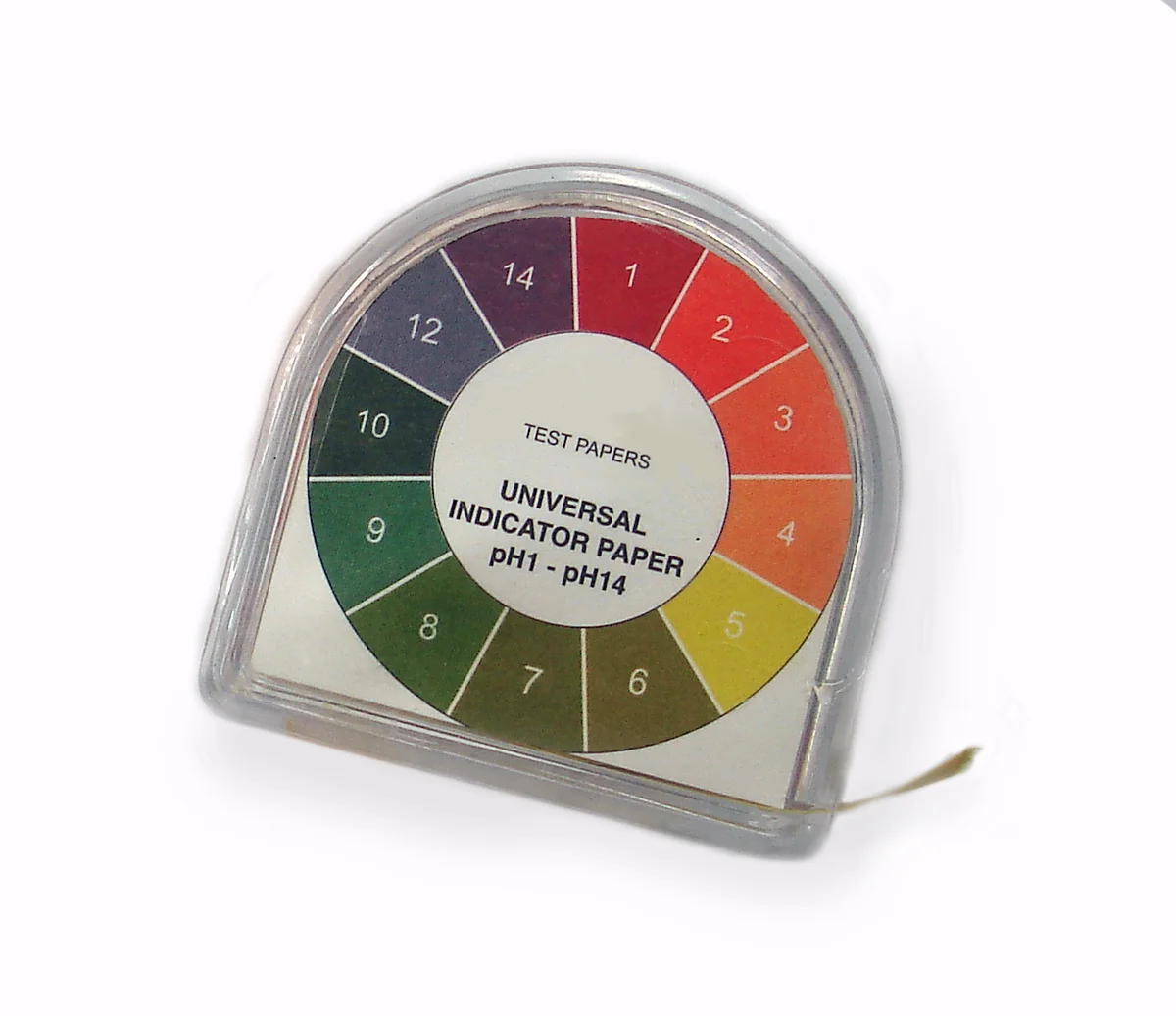
Source: Wikimedia Commons (CC0 Public Domain, Bordercolliez)
Activity 2.12: Testing the pH of Agricultural Soil
Collect $2\text{ g}$ of garden soil in a test tube, add $5\text{ mL}$ of distilled water, shake well, and filter. Test the filtrate with universal indicator paper. Optimal soil pH for crop cultivation is generally between $6.5$ and $7.5$.
Table 4: Significance of pH in Everyday Life
| Biological / Physical Domain | Crucial pH Threshold | Scientific Significance & Neutralisation Remedy |
|---|---|---|
| Human Physiological System | $\text{pH } 7.0 – 7.8$ | Enzyme catalysis operates within narrow alkaline limits. Blood pH tightly buffered at $7.4$. |
| Acid Rain in Ecosystems | $\text{pH} < 5.6$ | Acid rain lowers aquatic pH, killing fish eggs and causing marble cancer on monuments. |
| Human Digestive System | $\text{pH } 1.2 – 2.0$ | $\text{HCl}$ activates pepsin. Hyperacidity is neutralised by antacids (Milk of Magnesia). |
| Oral Cavity (Tooth Decay) | $\text{pH} < 5.5$ | Acidic bacterial fermentation corrodes enamel. Alkaline toothpaste neutralises acid. |
| Natural Self-Defense (Stings) | Methanoic Acid | Bee stings and nettle hairs inject $\text{HCOOH}$. Neutralised by baking soda or dock leaf juice. |
4. Salts, Chlor-Alkali Process, and Industrial Chemicals
Activity 2.13: Families of Salts
Salts having the same positive or negative radicals belong to a family (e.g., Sodium salts: $\text{NaCl}, \text{Na}_2\text{SO}_4$; Chloride salts: $\text{NaCl}, \text{KCl}$).
Activity 2.14: The pH of Salt Solutions
A salt of a strong acid and a strong base has $\text{pH} = 7$. A salt of a strong acid and a weak base has $\text{pH} < 7$ (acidic). A salt of a strong base and a weak acid has $\text{pH} > 7$ (basic).
The Chlor-Alkali Process (Manufacture of NaOH, Cl₂, and H₂)
When electricity is passed through aqueous sodium chloride (brine), it decomposes into $\text{NaOH}, \text{Cl}_2$ gas at the anode, and $\text{H}_2$ gas at the cathode: $$2\text{NaCl}(\text{aq}) + 2\text{H}_2\text{O}(\text{l}) \to 2\text{NaOH}(\text{aq}) + \text{Cl}_2(\text{g}) + \text{H}_2(\text{g})$$
Industrial Membrane Electrolytic Cell for Chlor-Alkali Process
Activity 2.15: Water of Crystallisation in Hydrated Crystals
Heating blue copper sulphate crystals in a dry boiling tube releases water droplets and leaves white anhydrous $\text{CuSO}_4$. Adding water restores the blue color: $$\text{CuSO}_4 \cdot 5\text{H}_2\text{O} \text{ (Blue)} \rightleftharpoons \text{CuSO}_4 \text{ (White)} + 5\text{H}_2\text{O}$$
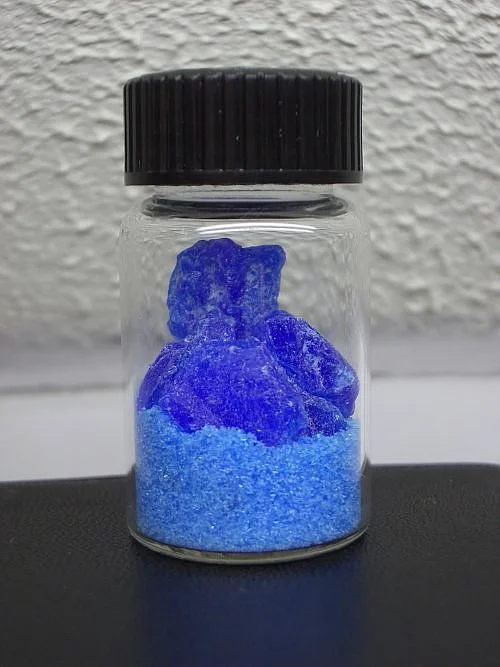
Source: Wikimedia Commons (CC BY-SA 3.0, W. Oelen)
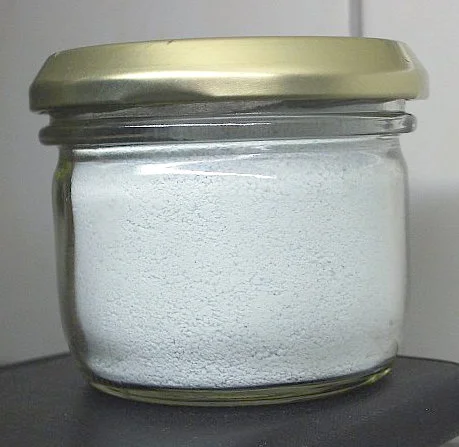
Source: Wikimedia Commons (CC BY-SA 3.0, W. Oelen)
Table 5: Commercial Chemicals Synthesized from Common Salt
| Chemical Product | Formula | Synthesis Reaction | Primary Applications |
|---|---|---|---|
| Bleaching Powder | $\text{CaOCl}_2$ | $$\text{Ca(OH)}_2 + \text{Cl}_2 \to \text{CaOCl}_2 + \text{H}_2\text{O}$$ | Bleaching textiles and wood pulp; sterilizing water |
| Baking Soda | $\text{NaHCO}_3$ | $$\text{NaCl} + \text{H}_2\text{O} + \text{CO}_2 + \text{NH}_3 \to \text{NH}_4\text{Cl} + \text{NaHCO}_3$$ | Baking powder component; antacid; fire extinguishers |
| Washing Soda | $\text{Na}_2\text{CO}_3 \cdot 10\text{H}_2\text{O}$ | $$\text{Na}_2\text{CO}_3 + 10\text{H}_2\text{O} \to \text{Na}_2\text{CO}_3 \cdot 10\text{H}_2\text{O}$$ | Glass and paper manufacturing; removing water hardness |
| Plaster of Paris | $\text{CaSO}_4 \cdot \frac{1}{2}\text{H}_2\text{O}$ | $$\text{CaSO}_4 \cdot 2\text{H}_2\text{O} \xrightarrow{373\text{ K}} \text{CaSO}_4 \cdot \frac{1}{2}\text{H}_2\text{O} + 1\frac{1}{2}\text{H}_2\text{O}$$ | Bone fracture casts; ornamental ceiling mouldings |
Table 6: Common Hydrated Salts and Water of Crystallisation
| Salt Name | Chemical Formula | Water Molecules per Formula Unit | Colour of Crystals |
|---|---|---|---|
| Copper Sulphate Pentahydrate (Blue Vitriol) | $\text{CuSO}_4 \cdot 5\text{H}_2\text{O}$ | 5 | Deep Blue |
| Ferrous Sulphate Heptahydrate (Green Vitriol) | $\text{FeSO}_4 \cdot 7\text{H}_2\text{O}$ | 7 | Pale Green |
| Sodium Carbonate Decahydrate (Washing Soda) | $\text{Na}_2\text{CO}_3 \cdot 10\text{H}_2\text{O}$ | 10 | Transparent White |
| Gypsum (Calcium Sulphate Dihydrate) | $\text{CaSO}_4 \cdot 2\text{H}_2\text{O}$ | 2 | White Crystalline Solid |
| Plaster of Paris | $\text{CaSO}_4 \cdot \frac{1}{2}\text{H}_2\text{O}$ | 1/2 | Fine White Powder |
Chapter Resource Hub — Class 10 Science
Access related study assets of Chapter 2 in one click.
Revision Notes / संक्षिप्त नोट्स
Fast track revision summaries and memory maps.
Interactive MCQs / बहुविकल्पीय प्रश्न
Self-practice quiz to test chapter concepts.
Important Questions & Answers
Board pattern short/long questions solved.
Previous Year Questions (PYQs)
Last 10 years solved paper segments.