CBSE Class 10 Science Chapter 3: Metals and Non-metals comprehensive detailed study notes aligned strictly with the updated NCERT syllabus for 2025-26. Covers physical and chemical properties, the reactivity series, electron dot representations of ionic compounds, metallurgy (roasting, calcination, thermite reduction), electrolytic refining, corrosion kinetics, and commercial alloys.
1. Physical Properties of Metals and Non-metals
Elements can be classified into metals and non-metals based on their characteristic physical and electronic configurations.
Definition 1: Metals
Elements that tend to lose valence electrons to form electropositive cations ($\text{M} \longrightarrow \text{M}^{n+} + n\text{e}^-$) are called metals. Examples include iron ($\text{Fe}$), copper ($\text{Cu}$), aluminium ($\text{Al}$), magnesium ($\text{Mg}$), and sodium ($\text{Na}$).
Definition 2: Non-metals
Elements that tend to gain electrons to form electronegative anions ($\text{X} + n\text{e}^- \longrightarrow \text{X}^{n-}$) are called non-metals. Examples include carbon ($\text{C}$), sulphur ($\text{S}$), iodine ($\text{I}$), oxygen ($\text{O}$), and hydrogen ($\text{H}$).
Table 1: Physical Properties of Metals vs Non-metals (with Critical Board Exceptions)
| Property | Metals | Non-metals | Key Exceptions (Exam Traps) |
|---|---|---|---|
| Physical State | Solids at room temperature | Solids or gases | Mercury (Hg) is the only liquid metal; Bromine (Br₂) is the only liquid non-metal. |
| Metallic Lustre | Possess brilliant shiny surfaces | Generally dull in appearance | Iodine (I₂) is a non-metal that possesses distinct metallic lustre. |
| Hardness | Generally hard and tough | Generally soft and brittle | Sodium (Na) & Potassium (K) can be sliced easily with a knife; Diamond (Carbon allotrope) is the hardest natural substance. |
| Malleability | High (can be beaten into thin sheets) | Non-malleable (shatter under impact) | Gold (Au) and Silver (Ag) are the most malleable metals. |
| Ductility | High (can be drawn into thin wires) | Non-ductile | Gold is the most ductile metal (1 g yields ~2 km wire). |
| Thermal & Electrical Conductivity | Excellent conductors of heat & electricity | Poor conductors (Insulators) | Silver & Copper are the best conductors; Lead (Pb) & Mercury (Hg) are poor conductors; Graphite is a non-metal that conducts electricity. |
| Sonorous Nature | Produce resonant sound on striking | Non-sonorous | School bells are manufactured from metals due to this acoustic resonance. |
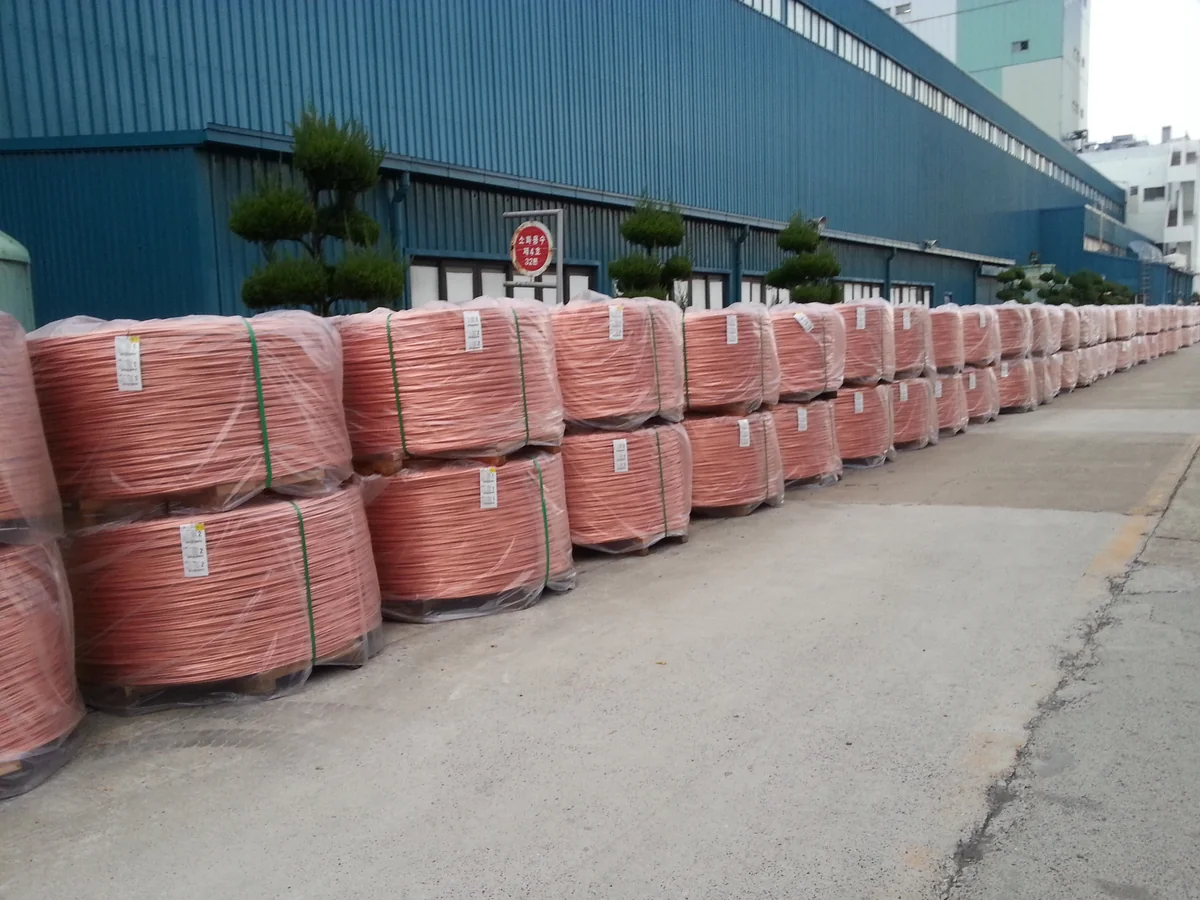
Source: Wikimedia Commons (CC BY-SA 3.0, LS Cable)
Activity 3.5: Investigating Thermal Conductivity of Metals
Procedure: Clamp an aluminium or copper wire horizontally onto a retort stand. Fix a pin to the free end of the wire using molten wax. Heat the wire with a burner near the clamp.
Observation: Heat transfers rapidly along the metallic wire from the heated zone toward the free end, melting the wax droplet and causing the pin to fall down.
Conclusion: Metals are excellent conductors of heat and possess high melting points.
⚠️ Examination Alert: Why is Sodium Stored Under Kerosene Oil?
Sodium ($\text{Na}$) and Potassium ($\text{K}$) are highly electropositive alkali metals that react exothermically with atmospheric oxygen and moisture at room temperature, generating flammable hydrogen gas that catches fire spontaneously. To prevent accidental explosions and isolate them from air, they are stored immersed in kerosene/mineral oil.
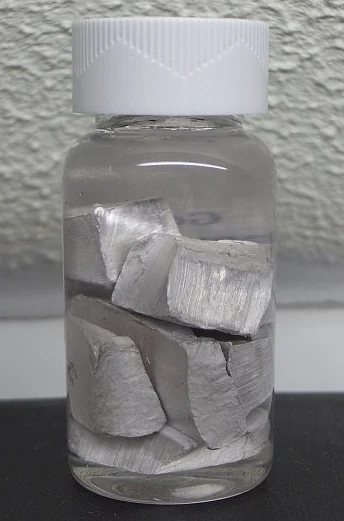
Source: Wikimedia Commons (CC BY-SA 3.0, W. Oelen)
2. Chemical Properties of Metals
2.1 Reaction of Metals with Oxygen (Combustion in Air)
Most metals combine with atmospheric oxygen upon heating to synthesize basic metal oxides:
Representative chemical reactions:
Definition 3: Amphoteric Oxides
Metal oxides that react with both acids and bases to yield salt and water are designated as amphoteric oxides. Aluminium oxide ($\text{Al}_2\text{O}_3$) and zinc oxide ($\text{ZnO}$) are benchmark amphoteric oxides:
2.2 Reaction of Metals with Water and Steam
Metals react with water to form metal oxide/hydroxide and hydrogen gas:
Table 2: Differential Reactivity of Metals Across States of Water
| Physical Form of Water | Reacting Metals | Balanced Reaction & Critical Phenomenon |
|---|---|---|
| Cold Water | Potassium (K), Sodium (Na), Calcium (Ca) | $2\text{Na} + 2\text{H}_2\text{O} \longrightarrow 2\text{NaOH} + \text{H}_2\uparrow + \text{Heat}$ Calcium reacts less violently; generated H₂ bubbles adhere to metal surface, causing calcium to float. |
| Hot Water | Magnesium (Mg) | $\text{Mg} + 2\text{H}_2\text{O(hot)} \longrightarrow \text{Mg(OH)}_2 + \text{H}_2\uparrow$ Magnesium does not react with cold water; bubbles of H₂ make it float on hot water. |
| Steam | Aluminium (Al), Iron (Fe), Zinc (Zn) | $3\text{Fe} + 4\text{H}_2\text{O(g)} \longrightarrow \text{Fe}_3\text{O}_4 + 4\text{H}_2\uparrow$ $2\text{Al} + 3\text{H}_2\text{O(g)} \longrightarrow \text{Al}_2\text{O}_3 + 3\text{H}_2\uparrow$ |
| No Reaction | Lead (Pb), Copper (Cu), Silver (Ag), Gold (Au) | Completely unreactive with water or steam at any temperature. |
Activity 3.10: Action of Steam on a Metal & Collection of Hydrogen Gas
When wet glass wool in a boiling tube is heated, steam passes over hot iron or aluminium granules. A magnetic metal oxide forms, and liberated hydrogen gas is collected via downward displacement of water inside an inverted test tube.
2.3 Reaction with Acids and Aqua Regia
Metals react with dilute acids to generate salt and hydrogen gas:
The Nitric Acid ($\text{HNO}_3$) Anomaly: Hydrogen gas is not liberated when metals react with nitric acid because $\text{HNO}_3$ is a powerful oxidising agent. It oxidises nascent $\text{H}_2$ into water ($\text{H}_2\text{O}$) and is itself reduced to nitrogen oxides ($\text{N}_2\text{O}, \text{NO}, \text{NO}_2$).
Exception: Magnesium ($\text{Mg}$) and Manganese ($\text{Mn}$) react with very dilute ($1\%$) $\text{HNO}_3$ to liberate $\text{H}_2$ gas.
Definition 4: Aqua Regia (Royal Water)
A freshly prepared fuming mixture of concentrated hydrochloric acid ($\text{Conc. HCl}$) and concentrated nitric acid ($\text{Conc. HNO}_3$) in a volumetric ratio of $3 : 1$. It is capable of dissolving noble metals such as gold ($\text{Au}$) and platinum ($\text{Pt}$).
2.4 The Reactivity Series and Displacement Kinetics
Definition 5: Reactivity Series
The reactivity series is an arrangement of metals in a vertical column in order of their decreasing chemical reactivities. A metal positioned higher displaces any metal below it from its aqueous salt solution.
Table 3: Comprehensive Reactivity Series with Extraction Strategy
| Reactivity Level | Element & Symbol | Mnemonic Guide | Extraction Strategy |
|---|---|---|---|
| Top Reactivity (High Affinity for Oxygen) | Potassium (K) | Please | Electrolytic reduction of molten chlorides or oxides |
| Sodium (Na) | Stop | ||
| Calcium (Ca) | Calling | ||
| Magnesium (Mg) | Me | ||
| Aluminium (Al) | A | ||
| Moderate Reactivity (Carbon Reduction Feasible) | Zinc (Zn) | Zebra | Roasting/Calcination followed by reduction with Carbon (C) or Aluminium |
| Iron (Fe) | In | ||
| Lead (Pb) | Library | ||
| [Hydrogen (H)] | [Reference] | [Standard Non-metal Datum] | |
| Copper (Cu) | Call | Heating sulphide ores (Roasting) or found in native free state | |
| Least Reactive (Noble / Unreactive) | Mercury (Hg) | Me | |
| Silver (Ag) | Smart | ||
| Gold (Au) | Goat |
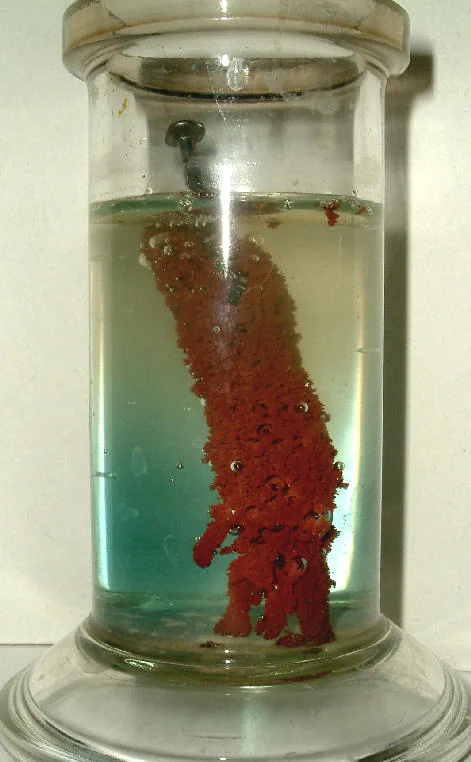
Source: Wikimedia Commons (GFDL, H. Hoffmeister)
3. Reaction Between Metals and Non-metals: Ionic Compounds
Metals lose electrons to attain stable noble gas octets, creating cations. Non-metals accept these electrons to complete their valence shells, forming anions. The electrostatic attraction binds them into crystalline lattices.
Definition 6: Ionic (Electrovalent) Compounds
Chemical compounds formed by the transfer of electrons from a metal to a non-metal are known as ionic or electrovalent compounds. They are held together by strong inter-ionic electrostatic forces.
Table 4: Physical Properties of Ionic Compounds and Scientific Rationales
| Physical Property | Experimental Behaviour | Underlying Scientific Rationale |
|---|---|---|
| Physical Nature | Hard, crystalline solids; brittle under pressure | Strong electrostatic forces hold oppositely charged ions in fixed lattice coordinates. Mechanical shear aligns like charges, inducing repulsive cleaving. |
| Melting & Boiling Points | Extremely high (e.g. NaCl MP = 1074 K) | Substantial thermal energy is required to overcome the colossal multidirectional inter-ionic electrostatic attraction. |
| Solubility | Soluble in water; insoluble in organic solvents | Polar water molecules exert high dielectric attenuation and hydration enthalpy, whereas non-polar solvents (kerosene, petrol) cannot solvate ions. |
| Electrical Conductivity | Insulators in solid state; conductors in aqueous/molten phases | Ions are immobilized in rigid solid lattices. Thermal melting or water dissolution breaks the lattice, providing mobile ions for charge transport. |
4. Extraction and Metallurgy of Metals
Definition 7: Minerals, Ores, and Gangue
- Minerals: Naturally occurring elements or chemical compounds found in the Earth’s lithosphere.
- Ores: Minerals containing a high percentage of a specific metal that can be extracted profitably and conveniently. (All ores are minerals, but not all minerals are ores).
- Gangue: Unwanted commercial impurities (sand, clay, silica, rocky matter) associated with raw mined ore.
Table 5: Roasting of Sulphide Ores vs Calcination of Carbonate Ores
| Parameter | Roasting | Calcination |
|---|---|---|
| Target Ore Type | Sulphide Ores (e.g. Zinc Blende, $\text{ZnS}$) | Carbonate Ores (e.g. Calamine, $\text{ZnCO}_3$) |
| Atmospheric Oxygen | Heated in the presence of excess air below melting point | Heated in limited air or absence of air |
| Byproduct Gas | Sulphur dioxide gas ($\text{SO}_2 \uparrow$) | Carbon dioxide gas ($\text{CO}_2 \uparrow$) |
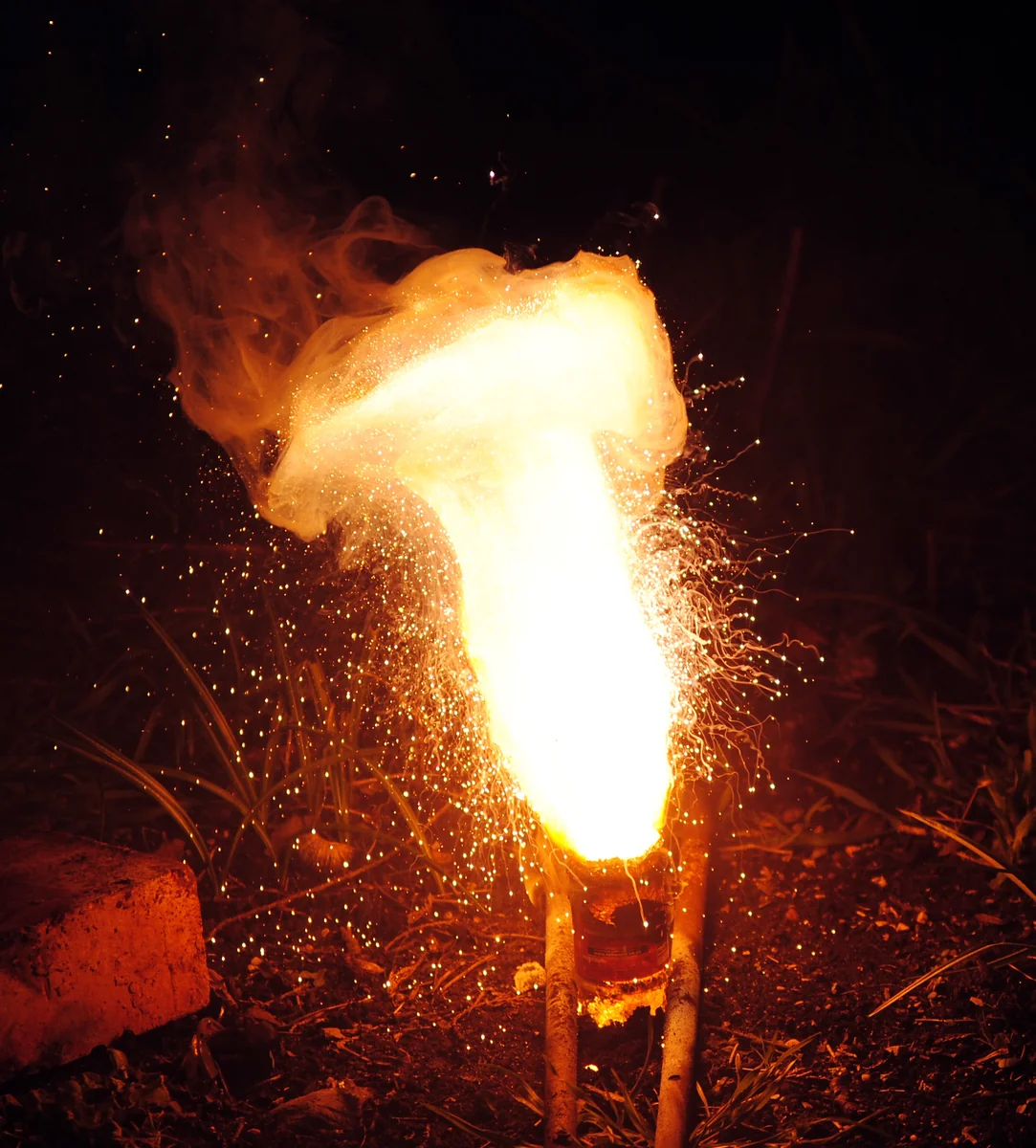
| Representative Equation | $2\text{ZnS} + 3\text{O}_2 \xrightarrow{\Delta} 2\text{ZnO} + 2\text{SO}_2\uparrow$ $2\text{Cu}_2\text{S} + 3\text{O}_2 \xrightarrow{\Delta} 2\text{Cu}_2\text{O} + 2\text{SO}_2\uparrow$ | $\text{ZnCO}_3 \xrightarrow{\Delta} \text{ZnO} + \text{CO}_2\uparrow$ $\text{CaCO}_3 \xrightarrow{\Delta} \text{CaO} + \text{CO}_2\uparrow$ |
Source: Wikimedia Commons (CC BY-SA 3.0, Nikthestunned)
4.5 Electrolytic Refining of Copper
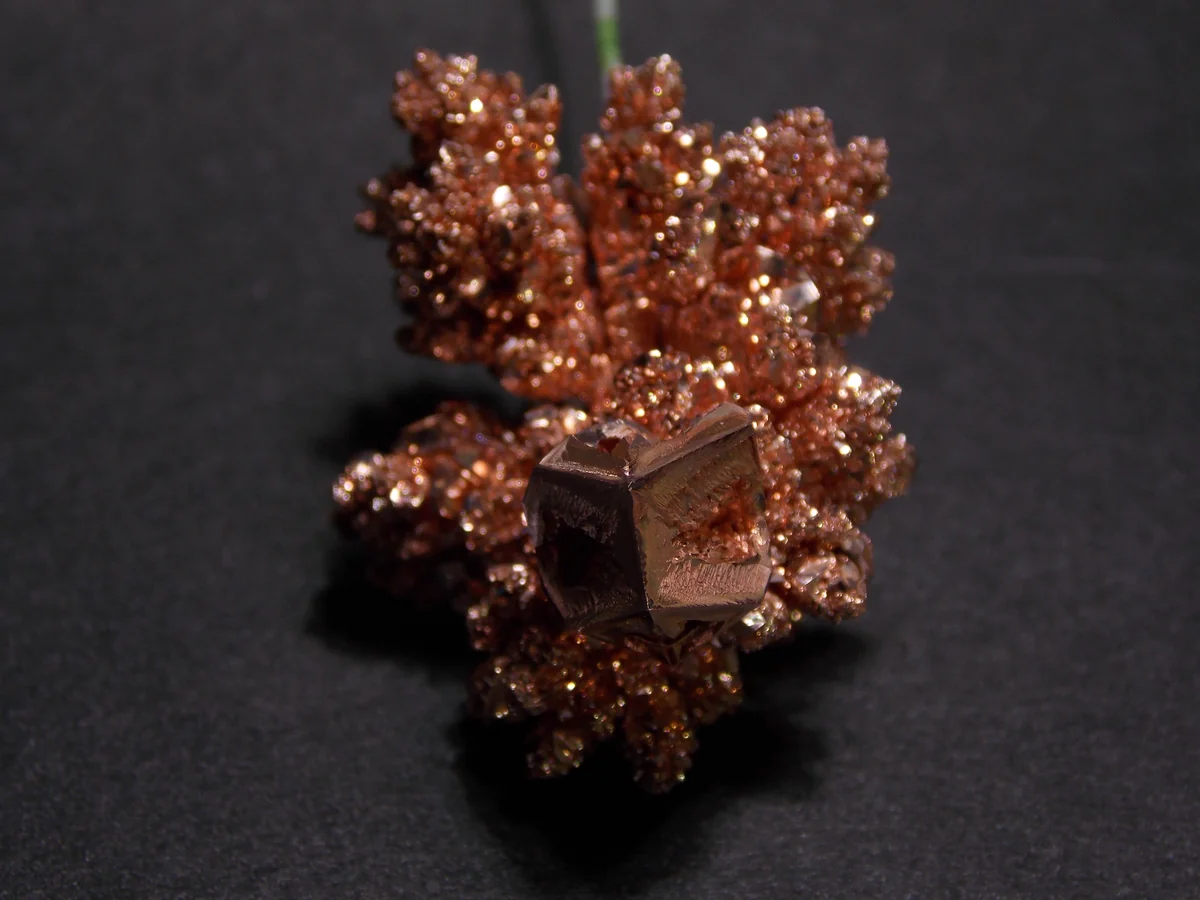
Crude metals obtained via pyrometallurgical reduction retain impurities. Electrolytic refining yields ultra-pure metals (99.99%):
- Anode (+): Slab of impure blister copper.
- Cathode (-): Thin foil of pure copper.
- Electrolyte: Acidified aqueous copper(II) sulphate ($\text{CuSO}_4 + \text{dilute } \text{H}_2\text{SO}_4$).
- Electrochemical Kinetics: Anodic dissolution ($\text{Cu} \longrightarrow \text{Cu}^{2+} + 2\text{e}^-$) transfers copper ions into the bath; equivalent $\text{Cu}^{2+}$ ions electrodeposit onto the cathode ($\text{Cu}^{2+} + 2\text{e}^- \longrightarrow \text{Cu}$).
- Anode Mud: Insoluble noble impurities (gold, silver, platinum) settle below the anode as a commercially valuable precipitate.
Source: Wikimedia Commons (CC BY-SA 3.0, Frey Saori)
5. Corrosion Kinetics and Prevention Methods
Corrosion is the oxidative deterioration of a metal caused by chemical reactions with atmospheric agents:
- Silver: Forms black silver sulphide ($\text{Ag}_2\text{S}$) on reaction with airborne sulphur traces.
- Copper: Reacts with moist carbon dioxide to form a green patina of basic copper carbonate ($\text{CuCO}_3 \cdot \text{Cu(OH)}_2$).
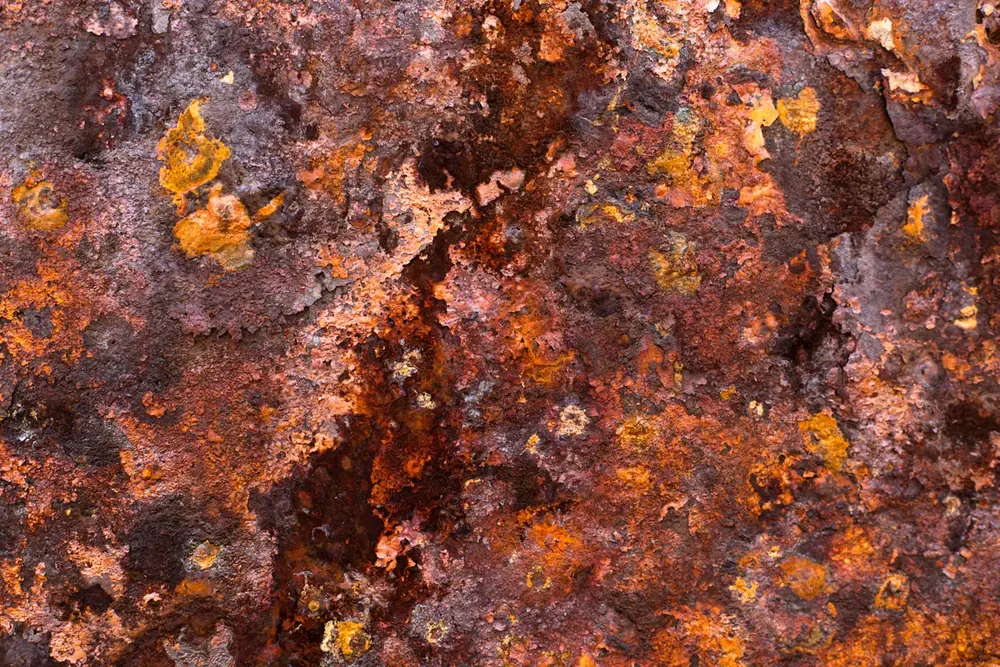
- Iron: Corrodes in moist air to produce hydrated iron(III) oxide rust ($\text{Fe}_2\text{O}_3 \cdot x\text{H}_2\text{O}$).
Activity 3.14: Investigating the Essential Conditions for Rusting
Three test tubes containing clean iron nails are prepared:
• Test Tube A: Water and air present ➔ Nails rust extensively.
• Test Tube B: Boiled distilled water (air expelled) topped with an oil film to bar oxygen ➔ No rust forms.
• Test Tube C: Dry air over anhydrous $\text{CaCl}_2$ (moisture absorber) with an airtight rubber stopper ➔ No rust forms.
Conclusion: Rusting requires the simultaneous exposure of iron to both atmospheric oxygen and water/moisture.
Source: Wikimedia Commons (CC BY-SA 3.0, Laitr Keiows)
Definition 8: Alloys
An alloy is a homogeneous mixture of two or more metals, or a metal and a non-metal. Alloying substantially enhances hardness, mechanical tensile strength, and corrosion resistance. When mercury ($\text{Hg}$) is a constituent, the resulting alloy is termed an amalgam.
Table 6: Engineering Alloys: Elemental Compositions and Industrial Applications
| Commercial Alloy | Elemental Composition | Engineering Attribute | Primary Application |
|---|---|---|---|
| Brass | Copper ($\text{Cu}$) 70% + Zinc ($\text{Zn}$) 30% | Acoustic resonance, lustrous gold finish, malleable | Musical instruments, decorative hardware, plumbing |
| Bronze | Copper ($\text{Cu}$) 90% + Tin ($\text{Sn}$) 10% | High hardness, friction resistant, poor electrical conductor | Statues, medals, currency coins, marine bearings |
| Solder | Lead ($\text{Pb}$) 50% + Tin ($\text{Sn}$) 50% | Exceptionally low eutectic melting point | Soldering electrical circuit joints and cables |
| Stainless Steel | Iron ($\text{Fe}$) + Nickel ($\text{Ni}$) + Chromium ($\text{Cr}$) + Carbon | High tensile strength; immune to rust | Surgical scalpels, cookware, chemical processing tanks |
| 22-Carat Gold | 22 parts pure Gold + 2 parts Copper or Silver | Optimal mechanical hardness (24-carat gold is too soft) | Fine jewellery and durable ornaments |
Chapter Summary & Key Learning Points
- Metals are malleable, ductile, good thermal/electrical conductors, and sonorous (Mercury is liquid).
- Most metal oxides are basic; aluminium oxide ($\text{Al}_2\text{O}_3$) and zinc oxide ($\text{ZnO}$) are amphoteric.
- Metals higher than hydrogen in the reactivity series displace hydrogen gas from water and dilute acids.
- Ionic compounds possess high melting points, dissolve in polar water, and conduct electricity in liquid/molten states.
- Sulphide ores are converted via roasting (excess air); carbonate ores via calcination (limited air).
- Thermite process ($\text{Fe}_2\text{O}_3 + \text{Al}$) produces molten iron for welding railway lines.
- Electrolytic refining uses impure anode, pure cathode, and acidified $\text{CuSO}_4$ electrolyte.
- Rusting requires oxygen and water; prevented by galvanisation, painting, and alloying.
Chapter Resource Hub — Class 10 Science
Access related study assets of Chapter 3 in one click.
Revision Notes / संक्षिप्त नोट्स
Fast track revision summaries and memory maps.
Interactive MCQs / बहुविकल्पीय प्रश्न
Self-practice quiz to test chapter concepts.
Important Questions & Answers
Board pattern short/long questions solved.
Previous Year Questions (PYQs)
Last 10 years solved paper segments.